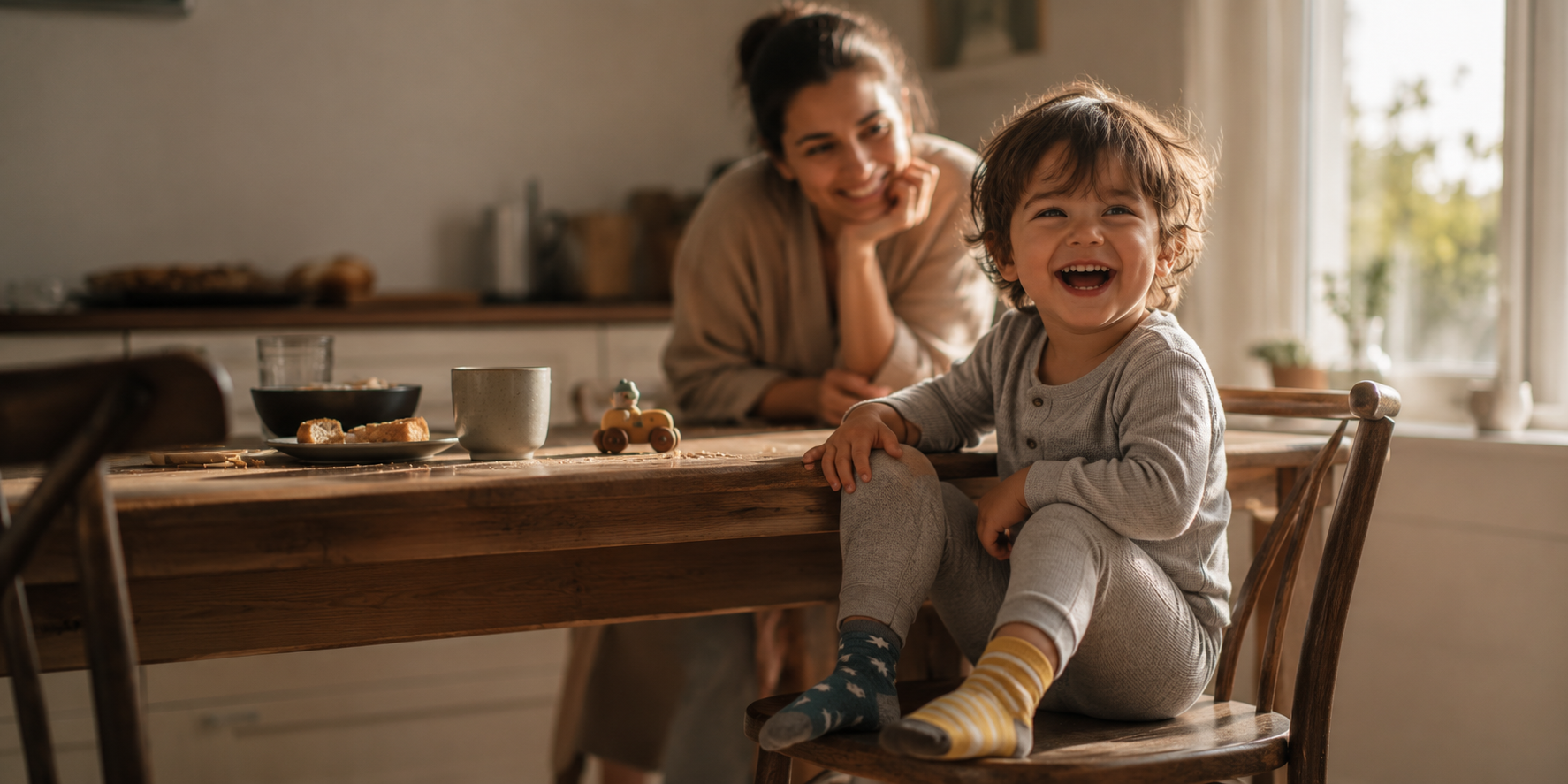
We remember them. But will our children?
We save the photos, but why do we forget the stories behind them? A closer look at how childhood memory works.
We remember them. But will our children?
In our own childhoods, family memories often lived in people's voices.
The way a grandmother repeated the same phrase with the same intonation every time. The way a father tried to laugh while telling an old story, then still became emotional. The way a mother looked at a photo and said, "That was such a strange day."
Years later, we understand that a memory is not only the event itself. A memory is also the way that story is told.
But today, even though we save so much for our children's future, we sometimes lose the most vivid part. The photo stays. The date stays. Hundreds of pictures stay on the phone. But the voice of that moment, the reason behind it, the small story inside it slowly fades.
Children want stories more than photos
When a child looks through a family album, the first question is often, "Who is this?" Then the more important questions arrive:
- How old was I here?
- Why was I laughing like that?
- What happened that day?
- Who chose these clothes?
- What were you feeling then?
The answers to those questions are not visible inside the photo. The photo opens the door, but the story takes the child inside.
Children recognize their past not through big dates, but through small details like these. A toy, a first step, a kindergarten morning, a rainy walk, a mother sitting nearby during an illness, the first time they said "dad." These things can seem ordinary to adults. For a child, they can become proof, years later, of "I was loved."
Memory grows when it is retold
Childhood memory is unusual. Some moments we remember ourselves. Others we remember because they were told to us.
For example, we may not remember a joke we made when we were little. But if the family tells that story for years, it becomes part of our identity. We are no longer just hearing about that moment; we are learning something about ourselves.
"You were so observant as a child."
"When you saw the sea for the first time, you were not afraid. You ran straight into the water."
"When you saw your little brother, you were the first to hold his hand."
Sentences like these explain a child's past. They give the child a way to see themselves through another loving pair of eyes.
Phone storage is not family memory
Our phones are full of photos. But that abundance sometimes makes memories even harder to see.
Among thousands of images, it becomes difficult to find one moment. And even when we find it, we often cannot remember where it was, who took it, or what happened that day.
Digital storage keeps many things, but it does not create a story by itself. Family memory needs selection. It needs someone to say, "This moment matters to us." It needs words, voice, and meaning added to it.
Choosing one photo and adding a one-minute voice memory can become the beginning of something very meaningful for the future.
Voice gives a child a feeling of closeness
Writing matters, but voice has a different kind of power.
When a child grows up and hears their mother, father, grandmother, or grandfather speaking about that moment, they receive more than information. They also hear the love inside the voice.
A parent's words, "I will never forget this day," will not sound ordinary in the future. That sentence shows the child how precious their childhood was to someone else.
Voice keeps hesitation, laughter, and tenderness. That is why a voice memory often feels more alive than a written note.
What does Memona change?
Memona was created not simply to store children's memories, but to help families bring those memories back to life in the future.
A parent adds a photo, speaks about the moment, or uploads a video. Memona turns that memory into text, helps shape it into a story, and makes it easy to share with selected family members.
Later, these memories can be gathered into a book with QR codes. Years from now, when the child opens the book, they do not only look at a picture. They can also listen to the voice behind that moment.
It is more alive than an album, more meaningful than a folder on a phone, and more shared than a private diary.
One memory today is enough
You do not need to gather an entire childhood in one day. The best beginning is actually very simple.
Choose one photo you love today and ask yourself:
- What is not visible in this photo?
- What did I learn about my child that day?
- How would I want to tell this moment to them years from now?
- What do I want them to feel when they hear this memory as an adult?
Sometimes a one-minute voice recording becomes a great gift years later.
Because one day our children will ask, "What was I like when I was little?"
When that day comes, let us have not only silent photos, but memories that can speak.